
Finding Growth That Sticks

Verne Harnish hits the FEDA Executive Leadership Conference stage to help foodservice distributors and manufacturers build companies that don’t buckle when growth kicks in.
Session InformationKeynote Presentation |
By Bridget McCrea
And Tim O’Connor
The foodservice equipment industry was built on a diverse blend of startups, small businesses, and larger established companies. Founder-driven firms operate alongside family-owned and generational businesses. Fast-growing new entrants share the market with organizations that have spent decades refining and expanding what they built years ago.
Every company has its own playbook, but a core set of business rules applies across the board. Distributors and manufacturers need the right people in the right roles, cash to support growth, and disciplined execution to transform ideas into reality. More importantly, they need a strategy that doesn’t fade once the focus shifts back to the daily work.
Verne Harnish has spent his career studying that exact challenge, and he’ll share his approach to solving it at this year’s FEDA Annual Executive Leadership Conference, Sept. 15-18 in Park City, Utah. As the author of Scaling Up: How a Few Companies Make It ...and Why the Rest Don’t and founder of Entrepreneurs’ Organization, Harnish focuses on the systems, habits, and accountability that help companies grow beyond their current stage.
Harnish’s insights are derived from more than four decades of helping companies turn ambitious visions into sustained growth through disciplined execution. His experience spans a range of industries, from designing HVAC systems for chain restaurants to serving as vice chair of the Riordan Clinic and chair of the Massachusetts Institute of Technology CEO program. The breadth of those experiences has given him a distinctive perspective on the leadership tenets and operational methods that enable organizations to scale successfully.
The philosophy and principles that Harnish will share with conference attendees build naturally on the ideas keynote speaker Jim Collins brought to last year’s event. At the 2025 conference, Collins, a highly-regarded business author and researcher, presented his flywheel concept, a way of visualizing how great companies build self-sustaining momentum through progressive actions. The flywheel structure was positively received by FEDA members, with some companies, like USA Restaurant Suppliers, developing their own versions.
“What made Jim Collins’ flywheel concept useful for us is that it turns strategy into something visual and repeatable,” Devon Zielinski, CEO of USA Restaurant Suppliers, said. “It is very easy to get pulled into the daily chaos: quotes, vendor issues, freight, substitutions, installs, service problems, customer timelines, and the constant pressure to move faster. The flywheel helped us step back and ask, ‘What are the few things that, if done consistently and repeatedly, create momentum for the entire business?’”
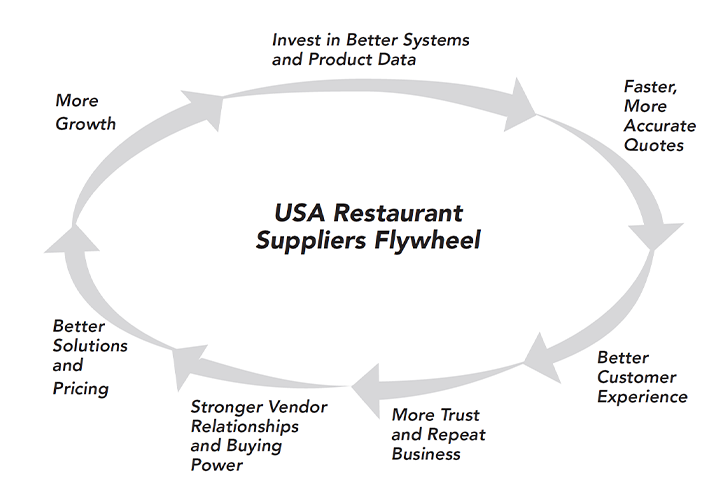
Through the development of its own flywheel, USA Restaurant Suppliers clarified that its mission is not merely to sell equipment. Rather, it is to remove friction from the process of purchasing equipment — one of the most frustrating parts of opening or operating a restaurant. The flywheel gave the distributor’s leadership and teams a map they can visualize to better align their work with the company’s overarching goals. “Instead of each department only thinking about its own tasks, we have asked them to think about how their work adds or removes momentum from the larger company flywheel,” Zielinski said.
The effect has been that everyone now sees how their role impacts the next piece of the company’s business. A delayed quote not only hurts sales, but it also erodes trust. The impact of a sloppy handoff goes beyond operations; it generates friction for the customer. For Zielinski, creating a flywheel clarified that adding more activity without the systems in place to support that growth created drag. “One of the biggest changes we made was putting more emphasis on process, data, and accountability before scaling further,” he said. “We started focusing more on quote accuracy, clean project handoffs, vendor follow-up, customer communication, and internal visibility. The goal became not just to grow, but also to create a business where each completed job makes the next job easier, cleaner, and more profitable.”
Where Collins showed conference attendees how disciplined thought and action build momentum, Harnish will focus on how companies can create the operating habits, priorities, and accountability needed to keep their flywheel turning. “For dealers and suppliers, the companies that grow sustainably will not just be the ones with the most products or the lowest prices. They will be the ones that build systems where people, strategy, execution, and cash all reinforce each other,” Zielinski said. “That is where the flywheel becomes powerful. It gives the organization a shared picture of how momentum is created, and Harnish’s framework helps make sure the business has the discipline to keep pushing the wheel in the right direction.”
When Growth Raises the Stakes
Today’s selling environment is a pressure cooker for distributors. Customers want faster answers, better service, more flexible solutions, and expert guidance on equipment, automation, and technology investments. Manufacturers want stronger dealer performance, better market coverage, and partners who can keep pace with new products and changing market demands. Foodservice equipment and supplies distributors are operating inside this reality while managing their own perfect storm of rising costs and tighter margins. As if those forces weren’t enough, they must also invest in technology upgrades, train their sales teams, and find new markets if they want to remain competitive against a new generation of eager rivals that are no longer limited by geographic boundaries.
That’s a lot to manage, and Harnish knows it. Some of the pressure points may be new, but the broader challenges aren’t. Companies have always struggled with growth, execution, communication, and cash flow. Today’s faster pace, rising complexity, and constant operational pressure have only intensified those problems. Through his business-centered books, executive coaching work, and training programs, Harnish has spent years helping companies deal with those issues. That work led him to develop the 4D Framework, which focuses on four areas: drivers, demands, disciplines, and decisions. Those elements connect back to the core business areas Harnish covers throughout Scaling Up: people, strategy, execution, and cash. People means putting the right employees in the right roles; strategy is knowing where the company wants to compete and how it plans to grow; execution means turning the plan into consistent daily action; and cash keeps the company financially healthy as it grows.
Each area closely corresponds to Collins’ flywheel concept, feeding one another in a virtuous cycle. Better people improve execution, which in turn protects cash. A stronger cash flow gives companies more room to invest, while a better strategy helps the team decide where that investment belongs. By making the right investments, organizations elevate their people and give them better tools with which to serve customers.
Everything Everywhere All at Once
“In our industry, Verne Harnish’s four drivers and critical areas are especially relevant because many dealers hit growth barriers that are not caused by lack of opportunity,” Zielinski said. “The demand is there. The problem is usually execution. Companies get stuck because the people are not aligned, the strategy is not simple enough, the execution rhythm is inconsistent, or cash gets trapped in inventory, receivables, freight problems, or poorly managed projects.” Without those pieces in place, growth can expose every weak spot the business has learned to work around.
Harnish puts people first in his framework because the team carries the plan. For FEDA members, that includes sales, service, project management, finance, and operations. The company has to know who owns what, who can handle more responsibility, and where the team needs more support before growth exposes those gaps.
Strategy comes next, but Harnish warns that it must be more tangible than merely some generic values posted on the office wall. Strategy should serve as a behavioral framework that guides the team to make better decisions every day. An effective strategy helps companies address questions such as which customers should be pursued? Which services should we grow? Which technology investments deserve attention now? Which opportunities don’t fit the business, even if the revenue looks tempting?
Execution turns those decisions into daily action. As Harnish explains in Scaling Up, this is where many companies lose momentum. The business gets busy, priorities shift, and managers spend too much time reacting instead of managing ahead. The remedy, Harnish writes, is for companies to create regular meeting rhythms, track the numbers that matter, and hold people accountable for the work they own. “Routine sets you free,” he wrote.
For dealers, that can mean tighter handoffs between sales and operations, better project tracking, faster follow-up on receivables, and fewer surprises between the quote and the final installation. None of that sounds glamorous, but in his conference presentation, Harnish will show how those daily habits often determine whether growth strengthens the business or creates bigger problems.
The final core business area, cash, closes the loop. Sales growth can drain cash quickly when projects stretch out, inventory costs rise, or customers take longer to pay. A company can stay busy and close deals but still feel pressure if cash doesn’t keep pace with the work.
Keep the Wheels Turning
In The 4 Decisions You Need to Scale Your Startup (with Proof!), Harnish walks through how the founders of Proof, a social marketing platform serving 20,000 websites, used the Scaling Up methodology to bring more structure, accountability, and discipline into a fast-growing business.
Starting with Harnish’s Function Accountability Chart (FACe), Proof’s leaders mapped out who owned which parts of the business. That exercise helped the founders divide work more effectively, spot operational gaps, and hand responsibilities to the people best equipped to handle them. According to Proof co-founder and CEO Dave Rogenmoser, the exercise also helped identify areas where the company previously lacked coverage, including treasury responsibilities that no one formally owned.
Next, Proof worked on strategy. The company chose “better conversions” as its promise to the market, then built a 14-day trial around it. It tracked two numbers tied directly to the customer experience: conversion improvement and self-installation time. This forced the company to answer some uncomfortable questions, such as: What did customers really care about? What promise could the company realistically deliver every time? Which numbers would prove the strategy was working?
Execution came next. Proof followed the 10 Rockefeller Habits (see sidebar), a Scaling Up tool that helps companies build stronger meeting rhythms, accountability, and follow-through. Instead of trying to adopt all 10 habits at once, Proof chose one habit per quarter and worked on it until it became an ingrained part of the team’s routine.
In the book, Rogenmoser states that the changes improved morale across the company because employees finally understood what the founders expected from them and where the business was headed. This revelation was the breakthrough Proof needed, and it led teams to operate with more predictability and confidence instead of reacting to constant firefighting and confusion.
Cash was the final piece of the puzzle. Proof started treating cash flow as part of the operating strategy, not just an accounting issue to review at the end of every month. That meant examining how growth affected timing, customer acquisition, and the pace of investment instead of just assuming rising sales would naturally solve those pressures.
For FEDA members, Proof’s success offers an example of Harnish’s lessons in action: Growth gets easier to manage when the company knows who owns the work, what customers have been promised, the habits that keep execution on track, and where revenue is actually going. Sure, the specifics may change from one company to the next, but Harnish’s principles apply across the board: the process of scaling up quickly exposes weak systems, especially when businesses rely too heavily on memory, informal communication, and a handful of overextended employees to keep the wheels turning.
Whether a company is managing rapid growth or working to break through a plateau, the challenges Harnish addresses — misaligned people, unclear strategy, inconsistent execution, and cash that can’t keep pace with opportunity — are ones that nearly every FEDA member has encountered. His keynote presentation at the FEDA conference promises to deliver a proven framework that leaders can carry back to their organizations. For distributors and manufacturers competing in one of the most demanding selling environments in recent memory, that kind of clarity may be the most valuable thing they take home from Park City.
The 10 Rockefeller Habits
Built on the management principles that helped Standard Oil founder John D. Rockefeller scale one of history’s most successful companies, Verne Harnish’s 10 Rockefeller Habits provide business leaders with a framework for creating better routines, strengthening accountability, and keeping daily operations on track. The principles are:
- Healthy team: Build a team that communicates well, trusts each other, and can solve problems without constant conflict.
- Focus on the No. 1 thing: Keep the company centered on the top priority instead of chasing too many goals at once.
- Meeting rhythms: Use regular meetings to keep teams informed, accountable, and focused.
- Clear accountabilities: Make sure employees understand what they own and what results they’re responsible for.
- Employee feedback: Create regular opportunities for employees to share concerns, ideas, and operational issues.
- Customer feedback: Stay connected to the customer experience and potential service problems.
- Values and purpose: Reinforce what the company stands for and how employees should approach the work.
- Strategy everyone can explain: Build a strategy simple enough for employees to understand and communicate consistently.
- Knowing what makes a great day or week: Help employees understand what successful performance looks like in their roles.
- Visible plans and performance: Keep priorities, goals, and performance metrics visible across the organization.
The 4D Framework
Verne Harnish’s 4D Framework helps companies simultaneously manage growth across four core areas:
- Drivers: The goals pushing the business forward, including expansion, succession planning, stronger margins, service growth, or a new customer category.
- Demands: The pressure those goals create for people, inventory, communication, project timing, and cash flow.
- Disciplines: The routines and rules that keep the business from running on memory, personality, or daily fire drills.
- Decisions: The questions the team must answer repeatedly as the company grows, including who belongs in which role, where the company should compete, and how it will fund growth.