
What a Tech Revolutionary Can Teach Foodservice Equipment
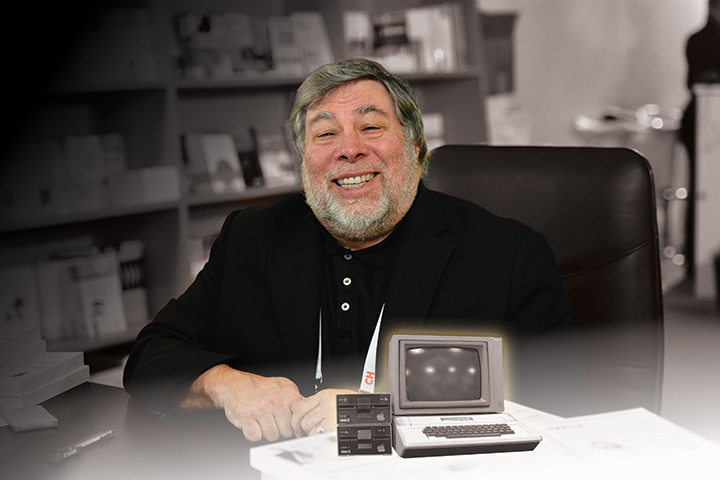
As data solutions and artificial intelligence reshape how businesses operate, Apple co-founder Steve Wozniak’s playbook offers distributors a timeless guide for navigating disruption.
Session InformationSpecial Guest Presentation |
By Tim O'Connor
Communications Manager and Editor
When the Apple II was launched in 1977, it contained several key innovations that propelled it to become one of the first mass-produced personal computers. Aimed at consumers rather than businesses, the computer needed to be something regular Americans would want in their homes and understand how to use. Its most defining feature was the ability to display color graphics, something few consumer-grade PCs had done at the time. It also included paddles for video games, a 52-key keyboard, and built-in sound. The vision for an all-encompassing machine that valued the entire user experience helped establish the customer-focused design philosophy that remains central to Apple today — and has made it a model for companies across every industry.
For Steve Wozniak, a co-founder of Apple and the engineer who designed the Apple II, it was a legacy-defining moment. But it was also the culmination of skills Wozniak had been developing since childhood. In his autobiography, iWoz: Computer Geek to Cult Icon, Wozniak writes about the role a rudimentary calculator he designed for an eighth-grade science fair played in his later success. The calculator could only add and subtract numbers up to 1,023, but it was closer to real computing than anything else Wozniak had made before. Even more importantly, it taught him the value of patience. “I learned to not worry so much about the outcome, but to concentrate on the step I was on and to try to do it as perfectly as I could when I was doing it,” he wrote.
It’s a lesson Wozniak believes that more engineers would benefit from, but it is equally useful for business leaders who often feel compelled to chase the next opportunity before mastering the current one. When a new technology comes along or there’s a chance to expand into a new market, it can be easy to get caught up in that potential and lose focus on the foundational work needed to get there. Wozniak reminds us that gradual learning and iteration are essential to the process, whether someone is figuring out the logic gates for a digital circuit or developing the services that make for a successful distribution company.
Wozniak will share those lessons directly with FEDA members at the 2026 FEDA Annual Executive Leadership Conference, Sept. 15–18 in Park City, Utah. During his 60-minute fireside chat, he will discuss Apple’s early days and share how the company created a culture of innovation that persists to this day. Attendees will learn what it was like to be at the dawn of the technological revolution from the viewpoint of one of the key figures that ushered in today’s digital age. Wozniak’s vital contributions have made him an inductee into the National Inventors Hall of Fame and given him intimate insight into how technology progresses and its impact on businesses.
“Mr. Wozniak had a front-row seat to some of the most significant technology disruptions in recent history,” said Jonathan Gustafson, president of Ace Mart Restaurant Supply. “His story and lessons will be valuable as we face new technology disruptors that claim to provide significant impacts on scaling our operations.”
Through a guided conversation on the main stage, facilitator Gene Clark, CEO of Clark Associates, will connect Wozniak’s understanding of the path of innovation to his observations on today’s technology disruptions, including the emergence of artificial intelligence (AI) as a business resource. At a moment when business leaders are under pressure to adapt to new but unproven technologies, Wozniak’s career offers a practical lens for understanding how turning points can translate into actionable strategies.
“Leaders must embrace change and sometimes that means adopting a founder’s mindset and challenging the current state of our businesses so that we can evolve for the future,” Gustafson said. “Mr. Wozniak’s experiences should serve as inspiration for distribution leaders as we confront the challenges we are facing.”
Solving the Problem Before It’s Known
At first glance, the computer industry of the 1970s that Wozniak, his partner Steve Jobs, and early Apple employees were trying to break into has little in common with foodservice equipment and supplies. For one, the computer industry itself was still a relatively new concept at the time. Microprocessors that shrank computers from the size of a room to a device that could sit on a desk were only a few years old when Wozniak was designing the first Apple products.
By contrast, the foodservice equipment and supplies industry was already well-established by the mid-1970s. FEDA itself had been around for 43 years by the time Apple was founded in 1976, and several member companies are even older than that. But while the industries were in different stages of maturity, many distributors can still see themselves in Apple’s story. Wozniak and Jobs started Apple in Jobs’ childhood home in Los Altos, California, and many distribution leaders — or their parents — have similar stories of warehousing equipment in their basements and working on balance sheets over the dinner table before they were able to move the business into its own space.
The common denominator between Apple and the distribution companies that have endured over the years is their focus on customers and their passion for solving problems, according to Brad Pierce, president of Restaurant Equipment World.
“You look back at the early days and we were a bunch of mom-and-pops with scrappy companies,” said Pierce, a technology aficionado whose foodservice solutions are frequently powered by Apple products. “Apple started in the same situation; it was a few guys working out of a family home who were consumed with their business. When Steve [Wozniak] started out, he engineered a good, reliable computer. He believed in his product and he believed in the company that Apple was building. Everybody in the foodservice equipment and supplies industry has lived that to some degree.”
Distributors are more sophisticated and nimble today. Modern technology powers e-commerce and communication tools that enable them to sell across the country. Competitors are no longer just down the street, but on every street in every market — and each one is offering a new service or product that is designed to capture more operators. Staying relevant in today’s fiercely competitive environment still comes back to the fundamentals of taking care of customers. “When you’re serving somebody and you’re trying to do the right thing and have a positive impact, you need to solve a problem for them,” Pierce said. “And he and Steve Jobs were solving problems that people didn’t realize they had.”
When designing the Apple II, Wozniak fought for the machine to have eight expansion slots (Jobs wanted only two). This allowed buyers to add much more functionality, including floppy disk drives, upgraded graphics, networking modems, and even real-time clocks. The decision effectively created one of the first open hardware ecosystems, as third-party manufacturers were able to develop and sell peripherals that pushed the boundaries of what computers could do. Nearly 50 years later, there are still hobbyist companies marketing expansion devices that add modern features such as Wi-Fi connectivity and HDMI inputs to the long-out-of-production computer model.
In many ways, the Apple II’s expansion slots proved the value and utility of letting third parties build on an open architecture rather than locking buyers into a closed system. This correlation between openness and innovation has been revalidated with each new generation of technology in every industry. In foodservice equipment and supplies, the FEDA Data Portal project was born out of a similar need for an open platform to distribute and disseminate product data between manufacturers and distributors. Just as the Apple II’s expansion slots fueled a cottage industry of peripheral makers, a goal of the FEDA Data Portal is to attract technology solutions providers who can similarly build universal and niche products powered by the industry-owned database.
“Wozniak’s insistence on providing more expansion slots spurred third parties to embrace the platform and work together creating the ecosystem as partners,” Pierce said. “The FEDA Data Portal is utilizing this same methodology which will spur innovative solutions by enabling collaboration with industry partners.”
The broader lesson extends beyond technology. While Wozniak’s expansion slots created opportunities for developers to build new products, they ultimately created more value for customers by solving problems and unlocking capabilities that did not previously exist. Pierce believes the same principle distinguishes the most enduring foodservice equipment and supplies distributors.
“I would relate that in our industry to solving a problem that somebody may know that they have, but they don’t even see as solvable,” he said. Take for instance the most common trio of operator challenges: labor, efficiency, and consistency. Restaurant owners may view those as distinct issues, each needing its own solution, but Pierce said a savvy distributor can introduce them to combi oven equipment that cuts down the number of people they need to work in the kitchen while also increasing cooking speed without compromising quality.
“Operators don’t realize it doesn’t need to be the way that it is,” Pierce continued. “As an equipment distributor, we can provide them with those solutions. We can apply that same strategy Apple has done, where they say, ‘Hey, we have this device that can solve this problem and can make you more efficient and can untether you from your desk.’”
Rising Alongside Technological Disruption
The mindset Pierce describes closely mirrors the Apple Marketing Philosophy created by early investor and later CEO Mike Markkula. The one-page decree authored in January 1977 lists three concepts that have guided the company’s marketing approach ever since: empathy, focus, and impute. Of the first, Markkula simply said of customers: “We will truly understand their needs better than any other company.”
It’s within that environment that Wozniak and the Apple team found ways to use rapidly advancing technologies to deliver a better user experience and more useful products for their buyers. With technology in the midst of another major leap, many businesses are looking back at Apple’s example as they figure out how to integrate headline-making advancements into their organizations. For distributors and manufacturers, that means evaluating investments in automation, enterprise resource planning systems, data platforms, supply chain visibility, and e-commerce.
Much like personal computing in the late 1970s, AI is still in the early stages of proving its practical business applications. Wozniak’s perspective on how transformative technologies evolve may offer valuable context for business leaders trying to distinguish between lasting change and empty hype. The hour-long session at the FEDA conference gives foodservice equipment professionals a chance to hear how an industry-changing company like Apple succeeded in its own transformation from one of the people who lived the experience.
“Apple excelled at making their devices intuitive and keeping the end user top of mind,” Gustafson said. “Today, it’s easy to get distracted by the amazing innovations in AI and other technologies, but those innovations could lead us down the wrong path if we don’t keep customer experience in mind as we develop solutions. Learning from Apple’s experience will help me find balance between innovating just because I can versus developing solutions that customers need.”