
Proving Performance Before the Kitchen Ever Turns On
Modern equipment testing and validation programs help distributors justify specifications, reduce callbacks, and strengthen project confidence.
Most foodservice equipment distributors sell on reputation, relationships, and price, but fewer factor in what happens before that refrigerator, oven, or fryer leaves the factory. It’s there that stress tests, performance cycles, certification audits, and documentation converge to prove that a product will hold up to the rigors of a 365-day, three-meal commercial kitchen.
Equipment manufacturers have always invested in product validation and testing, but the tools and processes have grown far more sophisticated in recent years. For distributors, that testing can become a powerful sales and risk management tool. It’s verifiable proof they can reference when customers or consultants ask why one piece of equipment should be chosen over another.
“Strong testing essentially gives dealers a quality story that helps them provide value to the customer and also reduces their post-sale support burden,” explained Andrew Carroll, vice president of marketing at Refrigerated Solutions Group (RSG). “When you’re specifying and selling, you can point to proven standards and processes. That’s selling documented performance instead of just making claims.”
That distinction matters in a market where buyers scrutinize every line item and consultants influence major project decisions. A manufacturer that achieves ISO 9001 certification does a lot more than simply check a box — they let everyone in the buying chain know that their processes meet a documented, audited standard. Also, for distributors working with consultants and specifiers on major projects, a manufacturer’s ISO certification can be the deciding factor when two products are otherwise neck and neck.
Stringent testing translates into fewer callbacks and warranty headaches for distributors, who are often the first to hear from customers whose equipment doesn’t perform as promised. Manufacturers that test rigorously take that burden off the rest of the sales channel. Here’s how three suppliers are raising the bar on product validation and what that means for the distributors who represent them and the end customers who depend on their equipment.
Tough Testing for Harsh Environments
Commercial kitchens don’t treat equipment gently. CFS Brands Vice President of Product Design and Development Brian Demers knows this firsthand, and it shapes everything about how the Jersey Village, Texas-based company approaches product validation. “Restaurants are pretty abusive places for products, which take a beating both in the front and back of the house,” he said.
For CFS Brands, whose dinnerware and food storage products face constant exposure to high-temperature washing environments, that reality drives a continuous testing program that doesn’t stop once an item hits the market. Demers said the manufacturer tests materials regularly, even on products that have been in production for years, to ensure they still perform as expected. The goal? Catch potential problems before customers do.
“Our testing is all about preventing failure out in the field,” Demers said. “We understand those issues cost our customers time, energy and money, and it costs us the same.”
One of the biggest recent shifts in CFS Brands’ testing program involves materials compliance. California’s Prop 65 has long required regular testing and documentation, particularly for per- and polyfluoroalkyl substances (PFAS), but newer state-level regulations banning certain materials require companies to stay on top of an increasingly complex landscape.
To ensure compliance, Demers said the manufacturer uses third-party testing to add an independent layer of verification to its internal processes. ISO 9001 certification runs in the background of all of it. In fact, the standard is integrated into factory inspections, materials checks, and quality control at every stage of production. This is important, Demers noted, because ISO signals to distributors and their customers that the processes behind every product meet a documented, audited standard of quality — meaning they don’t just need to take the company’s own word for it.
Built and Tested In-House, From the Ground Up
Back at RSG, the company designs and manufactures its own refrigeration systems in-house. Because it both builds and tests under its own conditions before shipment, Carroll said RSG can refine the product before it reaches customers.
Carroll views that as a core competitive advantage, and not just a quality control measure, both for the company and its distributors. It works like this: Every product is put through a structured engineering gating process, where a cross-functional team checks progress against requirements at each stage before moving forward. The company’s ISO 9001 certification backs all of it up. “ISO ensures that quality isn’t dependent on circumstance or opinion,” Carroll stated. “We have processes, they’re disciplined, and they’re proven. That gives customers and partners confidence.”
That confidence is critical in a sector where costly food inventory is stored around the clock in RSG’s units, and where failure can create food safety risks and revenue losses. For foodservice equipment distributors, Carroll said that reliability around food safety is a conversation worth having with every customer who asks why they should pay more for a better-tested product.
He pointed to two recent examples where RSG’s investment in rigorous testing yielded positive results. One involves A2L refrigerants, which carry a lower global warming potential and fall under the American Innovation and Manufacturing (AIM) Act. These refrigerants behave differently than their predecessors, which led RSG to invest in new leak testing equipment compatible with A2Ls and to build a new testing process specifically for those products.
“You can’t afford to learn through field failures with new refrigerant technology,” Carroll said. To that end, the manufacturer has also formalized its use of Design Failure Mode and Effects Analysis (DFMEA), a structured process that asks, “What could go wrong?” during product design. Engineers identify potential failure points and address them before manufacturing starts. When the refrigerants being used are flammable or toxic (or both), identifying potential failure points before production starts isn’t just good engineering practice; it’s a safety imperative.
“We want to be prepared as EPA [Environmental Protection Agency] requirements around refrigerants continue to evolve,” Carroll said. “And we are.”
Building Quality Into Every Station
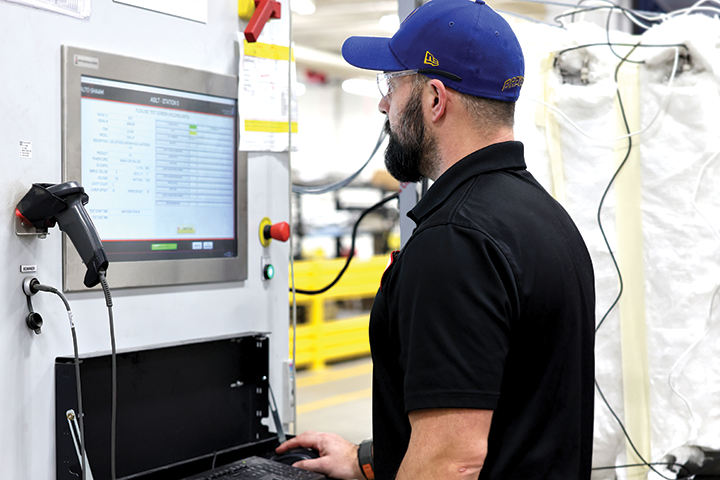
Some manufacturers test what they build, but Alto-Shaam tests while it builds. Based in Menomonee Falls, Wisconsin, the cooking, holding, and blast chilling equipment manufacturer folds quality verification directly into its production stations, using technology to catch problems at the moment they happen rather than after the fact. “To own your quality, you have to understand why you’re doing something and what the impact is if it’s not done correctly,” said Henry Billingsley, vice president of manufacturing. “Our mission is to make sure quality is verified at every product, every step and every workstation that we produce.”
Alto-Shaam uses camera systems and torque monitoring tools embedded directly in the assembly process. Take, for example, the placement of insulation in ovens, where proper installation is critical to performance. The manufacturer installed camera systems that verify insulation goes in correctly and in the right locations, then feeds that confirmation back to the operator before the build moves forward. It’s not a spot check after the fact, Billingsley explained, but a verification loop that’s built into the assembly itself.
Alto-Shaam uses a similar approach with critical mechanical components. Torque monitoring tools verify that blower motors, fan motors, and other moving parts get tightened to spec and confirm the joint wasn’t cross-threaded in the process. That data is trackable, Billingsley said, and Alto-Shaam is working toward tying it to individual serial numbers. That way, if an issue surfaces out in the field, the manufacturer can trace exactly what happened during production.
To further reinforce excellence in its manufacturing, the company draws on Advanced Product Quality Planning (APQP), a disciplined process developed by the auto industry, along with DFMEA to prioritize where those investments go. ISO 9001 certification and standards like UL underpin all of this and provide a documented framework for continuous improvement. For distributors, Billingsley says that kind of built-in verification changes the sales conversation. “If safety comes first and quality second, delivery and cost usually follow,” he adds. “Doing it right the first time prevents problems in the field and controls cost better than reacting later.”
As equipment becomes more complex and regulatory requirements more demanding, the ability to point to documented performance will only grow in importance. Distributors that understand how products are tested — and use that knowledge in the sales process — will discover fewer surprises in the field and more confidence at the point of sale.